 Skip to content
BLOG
“We Have to Make a Difference to Move Forward”: Ani Miller on Héroes
HispanoTV profiles Ani Miller and her talent for leadership, in Venezuela and beyond.
May 24, 2025 · Interviews · Leer en español
The HispanoTV program Héroes devoted an episode to Ani Miller and her talent for management, the same talent that has helped her stand out in a range of professional fields, both in her home country and abroad.
A conversation about leadership, hard work and the decision to make a difference.
The full conversation
On Héroes, a show dedicated to the stories of ordinary people with extraordinary paths, host Scarlet welcomed Ani Miller, a Caracas native and the founder of Ani Miller Services. Over an hour of conversation, Ani walked through her life: a childhood in Caracas when she had to hide in order to study, a banking career in which she rose at remarkable speed, the tragedy that forced her to leave Venezuela, and a hard start in the United States. At the end, she explained how every setback she faced as an immigrant became one of the services her company offers today, and she shared the advice she gives to people who come to her office looking to get their finances in order.
A childhood in Caracas and a father who did not want her to study
Scarlet opened by asking about Ani's roots: her childhood, her mother, her father and her family. Ani explained that she is the middle child. Her mother worked as an office administrator, and her father is a retired firefighter who, after retiring, devoted himself to owning several houses in Venezuela and renting them out, something he has done for years.
The surprising part came next. Ani always loved to read and study, but at home she faced an unusual battle: her father did not want her to study. When she told him she had an exam the next day, he would turn off the light and send her to bed. Scarlet could not believe it, since parents usually want exactly the opposite.
I would wait for him to fall asleep and then go into the bathroom to study by candlelight, so he wouldn't realize I was studying, because if I did it with the light on he would come and turn it off too.
As an adult, Ani understands that his attitude came from ignorance. She is the daughter of her father's second marriage, and none of her older half-siblings on her father's side had gone to college; having his children study simply was not part of his plans. Her mother, on the other hand, came from a family where going to college was the norm, and she always insisted that the girl be allowed to study. Ani waited until her father was asleep so as not to cause fights between her parents. Scarlet joked that maybe her father was using reverse psychology, because in the end Ani made it to college despite everything.
Studying at night, working by day and marrying at 18
After graduating from “liceo”, the Venezuelan equivalent of high school, at 16 or 17, Ani joined a program at INCE, a Venezuelan institute that lets companies receive tax benefits in exchange for sponsoring young people's training in a trade. Her sponsor was a bank, which paid her a salary while she spent a year learning all the theory behind the job of a business administrative assistant. At night she went to college to study public accounting.
To be free to study, she made a radical decision: she got married.
I decided to get married so I could leave home. I married my boyfriend at 18 and moved out so I could study. That was my way out.
Her boyfriend was also studying at INCE and at the same university, each in their own program, both in the evening session. When the year of theory ended, the year of practical training began, and Ani joined the bank as an intern. Laughing, she recalled that during that stage her best friend was the photocopier, and that she spent hours next to the fax machine waiting for it to stop giving a busy signal.
From intern to business advisor: the half hour that changed everything
Her performance as an intern was so strong that the bank offered to make her a direct employee, honoring the seniority she had already built as an intern. That is how Banco de Venezuela, then part of Grupo Santander, hired her as a customer service assistant.
That is where she began a habit that, in her view, explains a large part of her career. She had an hour for lunch, but used only half an hour to eat. For the other half hour she sat with the business advisors to learn the position she wanted to reach. She did it on her own time because, as she put it, during working hours she was being paid to do a different job.
I wanted to move up, and I knew I couldn't do it on work time because they were paying me to do one position. I took half an hour every day, Monday through Friday, to learn the next position.
She was 18. Scarlet asked whether she ever thought about going out to party with her husband and friends, like any young person. Ani admitted that her friends called her boring because she was always focused on work, and that she would tell them she wanted to get ahead, grow and not have money worries, and that doing so required preparation. It was not that she never went out: she went out on weekends, but during the week she came home exhausted from work and college. Looking back today, she is grateful she did it that way.
Six months into her role, a business advisor position opened up, and the branch manager was worried the numbers were going to drop. Ani offered to help. The manager could not understand how someone with barely six months in a different role could know how to do that job, so he put her to the test: he sat her down to serve a random customer, without knowing what that customer would ask for, while he watched. Ani handled it without any trouble, and the advisor she had been sitting with every day confirmed to the manager that Ani knew the entire job. Two days later she got an email from human resources: the manager was nominating her for business advisor, at double the salary. She was about to turn 19.
When Scarlet asked what she thought had made the difference, Ani did not hesitate:
Definitely always being willing to give a little more than what you're asked for. Every day you learn something new from anyone. Always having that humility. I think that has been a key to success for me.
Learning to deal with customers as a girl
Scarlet wanted to know whether dealing directly with customers came easily to her. Ani said it did, and that it went back a long way. From the age of 12 she worked with her mother, who at some point left her job as an administrator and started her own businesses, including a stationery store. Ani would go help her after school and on weekends instead of going out to parties. She had also worked with an advertising agency in Caracas that served major brands, which gave her a lot of contact with clients. On top of that, at a bank as large as that one, customers walked into the branch on their own.
A graduate, a promotion and an offer of nearly triple her salary
She graduated as a public accountant just as she was about to move into the next position. A friend of hers who held the role of small business executive (serving companies rather than individuals) received an offer to become a manager at another bank and left the position open. When Ani was offered that role, she replied that she knew that job too, because she used to help her friend. That is how she started as a small business executive.
Shortly afterward, the bank was taken over by the government, and many things changed that Ani did not agree with. Her friend, by then a manager at another institution, called and asked her to come be her small business executive, at almost three times the salary. Ani admitted she thought it over, because it was a small bank that almost nobody knew, while at Banco de Venezuela everyone wanted to be a customer. But at the interview she liked the energy of the boss, who promised her a place where everyone would know her name and where she could grow on her own merits. There, customers did not walk in on their own; you had to go out and find them.
Ani explained a detail about banking that motivated her: people who work at banks usually do not earn big salaries, but they do get many benefits and commission plans that keep them motivated. Between that, the financial offer and the idea of helping build something from scratch, she accepted.
A branch that had never met its goal
She joined the new institution in February. The vice president warned her that the branch they were sending her to had never met its goal. Ani answered with a confidence that surprised Scarlet: wherever she was, the goal always got met; she just needed them to be clear about what the goal was and what her duties were.
By the time she was finally settled in the branch, after the many checks involved in joining a bank, she had about six weeks left to close the quarter. She made a list and realized the team was very demoralized: they had never earned commissions, because they never met the goal, and as she pointed out, someone who has never earned a commission does not miss it, because they have never known it.
To top it off, her friend the manager had negotiated a month of vacation with her family in the United States when she took the job, so Ani was left in charge of the branch at just 20 years old, surrounded by people older than her who saw her as “la carajita,” as Venezuelans call a very young girl. Even so, she called a meeting.
I told everyone: folks, I come from this financial institution, these are my numbers. I'm asking you for a vote of confidence. We have 40 days to meet this goal. I'll bring in the business, but I need a team that backs me up.
She asked them to be quick: if she brought in ten accounts, they could not take three days to open them. She promised that the commission money would be shared among everyone. And she asked the teller for something specific: to offer every person who came in to cash a check the chance to open an account, because the teller was the one in contact with people, and customers needed to be connected to the bank.
We have to make a difference if we want to move forward. We can't just be a branch that cashes checks for people.
She also had an advantage: her own book of clients. She knew that if she knocked on a client's door, they would open it, because, as she said, people build relationships with people, not with institutions. The team gave her their vote of confidence, even if it came with some doubt. And they met the goal before March 31.
Loyalty before a promotion
That day, the vice president called to make sure she was at the branch and arrived together with the vice president of human resources and the vice president of operations. Ani feared something serious had happened with a client. Instead, they handed her a letter offering her the position of manager of that branch, her friend's job, while her friend was still on vacation. The vice president told her he would take care of talking to her friend when she returned.
Ani's answer was a flat no.
If there's one thing they taught me at home, it's to be grateful. I'll accept the promotion, but under no circumstances at this branch, because I'm not going to take the job of my friend, who recommended me.
The vice president was annoyed, but he ended up transferring her to the main branch, which was very large and already had an experienced manager, under whom Ani trained as a junior assistant manager. That she did accept, because there she was not taking anyone's job. Today that manager lives in the United States, and the two are close friends.
The story took a bitter turn before it was resolved. Someone leaked to her friend that Ani had been offered her job, without mentioning that Ani had turned it down. At the next monthly managers' meeting, when Ani went to hug her, her friend told her not to touch her. Ani chose not to explain and to let the truth come out on its own. Scarlet, intrigued, asked her not to leave the story there. Ani said her friend learned everything Ani had said from the assistant manager, who had been present at that meeting, and later apologized to her.
Scarlet noted that when you have values and respect people, more rewards and opportunities come your way. Ani agreed: you do not need to step on anyone to get ahead.
I'm not going to rise by sinking anyone.
Corporate banking and a bold interview
Ani lived for two or three years in Maracay, in the state of Aragua, where all of this took place. When she decided to return to Caracas, she was nominated for corporate banking, a different level where the clients are enormous. Scarlet took the opportunity to ask whether she ever worked as an accountant; Ani said no, that she devoted herself entirely to banking, because she loves finance.
There were four candidates for the position, and all of them except her had corporate banking experience. Ani went to the interview thinking that if she did not get it, she would keep trying. One of the vice president's questions was where she saw herself in the coming years. Her answer was: perhaps in his position, because she assumed he would want to keep growing until he became president, and then she could be the vice president.
I'm not here to take your job. You need to focus and work to grow, so that tomorrow you're the president and I can be the vice president.
The vice president told her no one had ever said anything like that to him, and in that same interview he asked whether she could stay on right away. Ani moved to Caracas and joined corporate banking.
A family business and changes in Venezuelan banking
Scarlet asked where her husband was in all of this. Ani explained that together they created an executive transportation and security escort company. She brought in the clients, laboratories and large companies, and he handled operations, with an administrator and several drivers with their own vehicles, taking executives to their meetings and to their homes.
Meanwhile, Venezuelan banking was going through government interventions. Ani became a branch manager for the first time at 20 or 21, and every time the government took over a bank where she worked, she looked for another private institution. In one of those moves she accepted the management of a branch in El Cementerio, a very commercial area in western Caracas with big markets, which has nothing to do with a graveyard despite its name. She was from the east side and did not know the west, but she did very well. Once again she found herself at a branch that had never met its goals, built a good team and did the same thing as before.
Scarlet asked whether she ever had those moments of weariness or self-sabotage when you think you have already lived through something and do not want to start over. Ani admitted she did, but that they do not last long.
I have my moment, and two minutes later I look in the mirror: okay, wake up, your little show is over, you have to keep going because there are things to learn here.
Her determination, she said, is a mix of her mother and her father. Since she was little, whenever someone told her something could not be done, she said it could. If something is not impossible, that means it is possible, and even if you fall short along the way, you come away with something you did not have before: experience.
Buying a house and the decision to divorce
One day, on the Caracas subway, Ani ran into a former coworker from Banco de Venezuela, who told her that everyone from the “old school” was moving to another bank and gave her his card so she could send her résumé. At that moment, Ani was in the middle of a divorce.
The marriage was no longer working because she had always aspired to grow, and her husband, like her friends, criticized her for thinking only about work. The breaking point came with the purchase of the house. At the bank she had been tasked with preparing the review of the files of the 500 largest borrowers, an annual audit every bank has to go through. She spent three or four very busy months, everything went perfectly, the bank was not fined, and as a reward the vice president of credit offered to finance 100% of whatever house she chose.
She came home excited, but her husband told her they were not ready. They were renting one of her father's houses, and he did not see the need. Ani replied that those houses belonged to her father, not to them, and that they already had two children: she had her first son at 21 and her daughter at 23. She told him she would buy it with or without him, and invited him to come see it on Saturday at ten. At nine, he asked her to wait for him while he got ready. They bought the house.
For Ani, a new financial responsibility required a change of habits, and that is advice she repeats to this day:
If you want to achieve something, you have to sacrifice something. You always have to be willing to sacrifice time, to sacrifice something.
She proposed concrete changes to her husband: if they ate out six times a month, now they would have to do it three times; a savings plan and a budget for certain expenses, so everything would run smoothly. He replied that this was exactly what he did not want. The house, moreover, was bought in “obra gris”, meaning unfinished, without finishes, paint, kitchen or appliances, and he did not want to remodel it either. In 2011, when her daughter was a year old, Ani proposed that they divorce on good terms.
I want to focus on finishing my house, I want to move into my house with my children, and I want to keep moving forward. If you don't want the same thing, I can understand that, but you can't hold me back. And I don't want to hold you back either.
Ani recalled that they had a very lovely marriage, that they were practically kids when they married, and that she did not want the relationship to be damaged. He did not want a divorce, but they ended up getting one.
A card on the subway and a salary that paid for the remodel
Ani forgot to send her résumé. Two weeks later, against all odds, she ran into the same coworker on the subway again. This time she had her résumé on a flash drive, and he took it. They called her that same day for an interview.
The interviewer turned out to be someone Ani knew from another institution, from Ani's time in corporate banking, the area that gives instructions to the branches. When she heard Ani's name, she told her she was qualified, but that the only openings were for executives, and she assumed a manager would not accept a lower position. Ani replied that it depended on the salary. The bank was paying very aggressive salaries to attract people with a book of clients, and the executive salary was double what she earned as a manager. She accepted. Two months later she was a manager again.
That bank had a commission plan with no ceiling: if you exceeded the goal, you were paid double. Ani hit two and three times the goal, and thanks to that she remodeled her entire house and moved in with her children. In total, she worked in banking for 12 years, from age 16 until she arrived in the United States at 28. In the divorce, she left the transportation company to her ex-husband.
The tragedy that forced her to leave Venezuela
Scarlet asked what the breaking point was that made her leave the country. Ani told the story calmly. The father of her children died in Venezuela: he was murdered while working an escort job, with the company that had kept operating after the divorce. Because he never got over the separation, he died with an ID card that still said he was married, and under Venezuelan law only the wife could claim the body. His parents called her, because otherwise they would have had to wait two or three weeks for the record to be corrected. Ani went and did it, as a favor to the family and because he was her children's father. That linked her personal information to the case.
A few months later she learned that his girlfriend, who had filed the police report, had also been murdered. Ani had not had any contact with him for a long time and did not know what was going on. Shortly afterward, while buying something at a kiosk on her lunch break, two armed men approached her, called her by name and demanded that she get into a van. She thought it was a robbery, but they told her no, that they knew she had claimed the body. In that instant she remembered what had happened to the girlfriend and decided she would not get in.
I left my shoes and started running barefoot, and the man shot at me. He hit me in the leg. Wounded, I kept running.
There were a lot of people in the area at that hour, and she managed to escape. After receiving medical care, and without really knowing what was happening, she decided for her safety to leave the country the next day with her children and her younger sister. She went to the Dominican Republic for 15 days, thinking things might get better. She did not want to abandon the life she had worked so hard for: she had already been a regional manager and had been offered the position of vice president of business.
But she was told that some people had gone looking for her at her workplace, and her mother, in tears, begged them to leave. She submitted her resignation at the bank, even though they offered to transfer her to another location, and told them she would be away for a while to see what happened.
Arriving in the United States “on vacation”
Ani arrived in Doral, in Miami, in 2016, with her two children and her sister, and soon afterward brought her mother. At first the idea was to take a vacation: she went with the kids to Orlando to visit the parks for about ten or fifteen days, because they were carrying a lot of trauma after being forced to leave. While there, she learned that people in Venezuela were still asking for her at the security booth of her condominium, and her mother begged her not to go back.
Ani then found a lawyer and told him everything that had happened, and he was the one who explained that her case qualified for asylum. She had all the documents to support her story, including the news reports published in the press. Ani stressed that, under no circumstances, did she want to stay in the country without legal status. She filed her case and decided to stay.
Telling her children that they were not on vacation but were staying was hard. They were young, but her son, who was a very good student, was deeply affected by starting at a school where everything was in English and he understood nothing. It was a change of culture, language, friends, everything.
The first scam: a friend, a car and a contract in English
Once settled in Doral, Ani relied on people she had met in banking and considered friends. One of them, who had been in the United States for three or four years and worked as a realtor, helped her rent a house and recommended where to buy a car. That is when what she calls her first scam happened, although she made clear she did not take it as something bad, but as a lesson that even led her to create Ani Miller Services.
While she was looking for a house and a car, she also created her company. Ani Miller Services is actually a DBA, a trade name; the legal company has another name, whose meaning, she said with a laugh, only her son knows.
To pay the bills she worked for every delivery and rideshare app out there: Uber, Amazon, DoorDash, Instacart. Scarlet asked her how it felt to do those jobs after everything she had achieved in Venezuela.
It was hard, but I knew I needed to pay the bills. Every time I felt bad, I looked in the mirror and told myself: this is not your reality. This is what you're doing right now to support yourself.
She understood very quickly that she had to learn English. Amazon Flex, a program for delivering packages in your own car, where she was one of the first drivers, allowed her to enroll in a college to study English Monday through Thursday mornings. In exchange, she had to work until midnight to cover expenses. She did that for a year.
It was during that time that she bought a car at the dealership her friend recommended. She did not speak English, and everything was in English. She signed where they told her to, put $5,000 down and was told she would pay installments of about $500 a month. A year and a half later, an undercover police vehicle crashed into her, and since she needed the car for work, she went to the dealership to trade it in. She asked how much she owed. The answer: $30,000.
She could not believe it. They explained that she had signed an in-house contract with the dealership itself, with no bank involved, in which she had agreed to pay 71 installments that were interest only, and a 72nd “balloon” payment that carried the full price of the vehicle. The $5,000 down payment had gone to administrative fees. She was left with a wrecked car, which was her work tool, and a $30,000 debt on a car that was not worth even half that.
That day I walked out of there crying. I got in the car and said: this can't be, why are people so cruel?
She thought about her friend, who had been in the country for years and could not have been unaware of what they were doing to her. She never confronted him; she simply distanced herself. She then decided to learn in depth how vehicle financing works in the United States, convinced that if they had done this to her, they were doing it to millions of people. She even promised herself not to do business with Latinos again until she was prepared, because the person who had hurt her was someone who knew she had arrived alone with two children, her mother and her sister.
Scarlet reflected that such people appear along the way to force us to learn. Ani agreed, with one nuance: in the moment you do not see it that way, you suffer; but if you decide to learn, the harm ends up turning into a benefit. If you do not, it leaves the person damaged, and for an immigrant that can be a very big problem.
The first service: helping people buy their car
That experience gave rise to her company's first service: advising people so they can buy vehicles without getting scammed on the terms. Ani recorded videos asking people whether they were tired of spending twelve hours at a dealership until they were worn out and signed anything. She negotiated the deal before the client arrived, acting as an intermediary, and the visit to the dealership lasted an hour.
Everything that has happened to me is a service I have provided.
Scarlet thanked her for using what she had lived through for the benefit of others, in an honest way, instead of seeking revenge or wanting others to suffer the same.
The IRS letter that led her to study taxes
The second service was also born from a bad moment. Ani had her taxes done by a preparer she paid, and then she received a letter from the IRS, the kind that causes people so much anxiety. She called the woman, who did not answer. Four days later, the assistant told her she would have to resolve the letter on her own, because they were busy. Ani, who comes from the “old school” of customer service, thought maybe it was the assistant who did not want to do the work, and went to the office in person. She waited two hours and nobody saw her.
She got in the car and thought that, as an accountant, she had no reason to be going through this. It was February, the height of tax season. She searched online for an institute that offered an intensive course, because she had 30 days to respond to the letter and five had already passed. She took a two-week course, even though it was hard to stop working in order to study, brought the letter to class, and they taught her how to resolve it.
Then she went in person to an IRS office with her children. There she discovered the problem: the preparer had entered her son's Social Security number incorrectly, and the wrong number matched that of a child who had died years earlier, so the IRS suspected someone was trying to use that child's information fraudulently. With her children present, she cleared up the error.
That is how her tax preparation service was born, and also her way of serving clients. Scarlet asked whether she, at least, answers the phone.
That will never happen to you. That's my motto: if a client calls, the client has a problem, and we are the solution. Our slogan is even “We are always here for you.”
Everything under one roof
Scarlet asked her to go over the services Ani Miller Services offers. Ani mentioned vehicle purchase advising, personal and corporate taxes, accounting, and insurance, licensed in all 50 states for every type of policy: health, life, liability, home and more. She said insurance also came about because of a personal experience. On top of that are real estate services, so a client can buy their property with guidance from start to finish. Scarlet summed it up as a complete package with everything a person needs to live in this country.
When the host asked how she feels today, Ani said she is happy, above all because she can guide her clients from her own experience.
It's not the same to tell someone they can do something if you haven't even done it yourself.
She said they have countless success stories from clients who came into the office not knowing what to do, and that just two days earlier a client had bought their third house. Ani explained that, through real estate and the tax benefits that investments allow, she herself has bought ten properties, all of them rented. She tells her clients that this is the path to securing their future, and she recommends a book that, in her view, changes anyone's life: Padre rico, padre pobre (Rich Dad Poor Dad) by Robert Kiyosaki, available in English and Spanish.
Her superpower: solving problems
As the interview neared its end, Scarlet asked whether she considers herself the heroine of her own story. Ani said absolutely. And when asked what her superpower is, she did not hesitate:
Solving problems. I love it when someone tells me they have a problem, because I'm always going to look for the solution. You have to call Ani Miller because she has the solution.
She described how she works when someone comes in for a financial advising appointment. The first thing she asks is: “Tell me all the problems that are keeping you up at night.” While the person talks, she writes everything down, because what she does is build them a plan. But before any plan, she makes a few conditions clear:
- Discipline. Reaching your financial goals takes discipline.
- Willingness to sacrifice. You have to be willing to give something up to achieve something big.
- Believing in yourself. We can all do it, but the first step is believing in ourselves.
- Not listening to people who haven't achieved anything. We often sabotage ourselves and listen to people who don't want us to succeed.
- Pushing through fear. The fear of things going wrong is what keeps us from winning.
Scarlet added that this fear often does not go away, and that the idea is to push through it and do it anyway. Ani completely agreed.
Growing with her own clients
To close, Scarlet asked whether more projects were on the way. Ani said they always want more and are open to possibilities. She shared something that especially excites her: as the company grows, it gives her the chance to bring her own clients onto the team, people who already know the service from the other side of the desk.
The interview ended with the host thanking her for telling her story and for not giving up. Ani Miller's journey, from the girl who studied by candlelight in a bathroom in Caracas to the businesswoman who today helps other immigrants with their taxes, insurance and finances, leaves a very clear message: every blow can become a tool, as long as you decide to learn from it.
Video: HispanoTV, the program Héroes.
This article is an English translation of the original Spanish version. Quotes have been translated from Spanish. Leer en español.
BOOK A VISIT
Let’s talk about your money
Leave your details and we will call you to understand your situation. We speak English and Spanish.
KEEP READING
More from the blog

“Trust Doesn't Mean You Stop Asking”: Ani Miller on La Mesa Caliente
On La Mesa Caliente, Ani Miller explains why handing all your finances to your partner can leave you vulnerable.
Read →
Ani Miller Services Turns 10: Univision KUKC’s Coverage
Univision KUKC was at the 10th anniversary celebration of Ani Miller Services with friends, family and clients.
Read →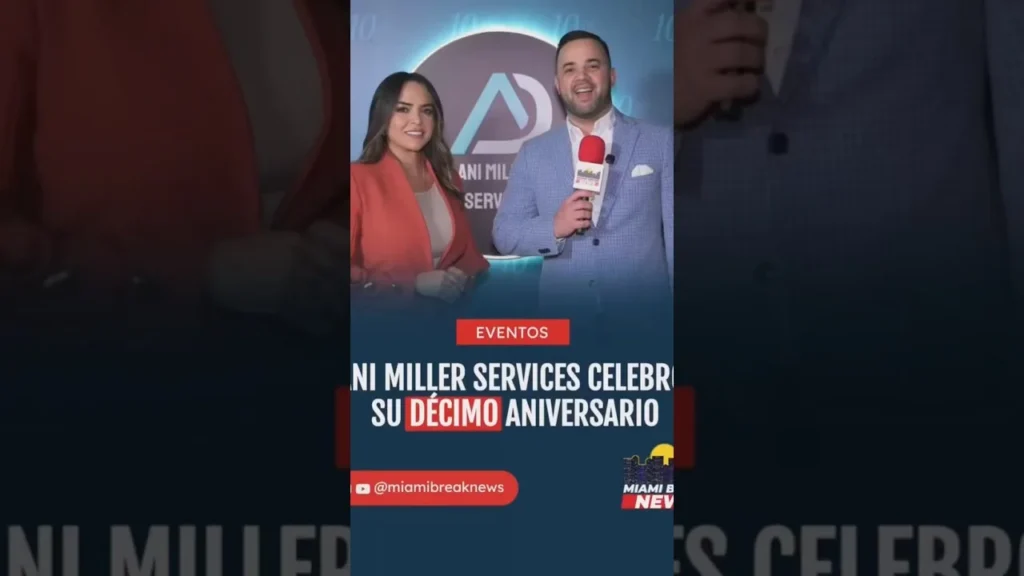
“Focused Discipline”: Ani Miller Services Celebrates 10 Years
Ani Miller celebrated her company's 10 years and her 39th birthday in Miami, and shared the key to her journey.
Read →YOUR NEXT STEP
Before you make an important decision about your money, talk to Ani.
A financial intelligence firm for individuals, families and business owners. In English and Spanish.
Notary Public. I AM NOT AN ATTORNEY LICENSED TO PRACTICE LAW IN THE STATE OF FLORIDA, AND I MAY NOT GIVE LEGAL ADVICE ABOUT IMMIGRATION OR ANY OTHER LEGAL MATTER OR ACCEPT FEES FOR LEGAL ADVICE.
© 2026 Ani Miller Services · Inversiones Los Palapunes Corp.
Ani Miller Services